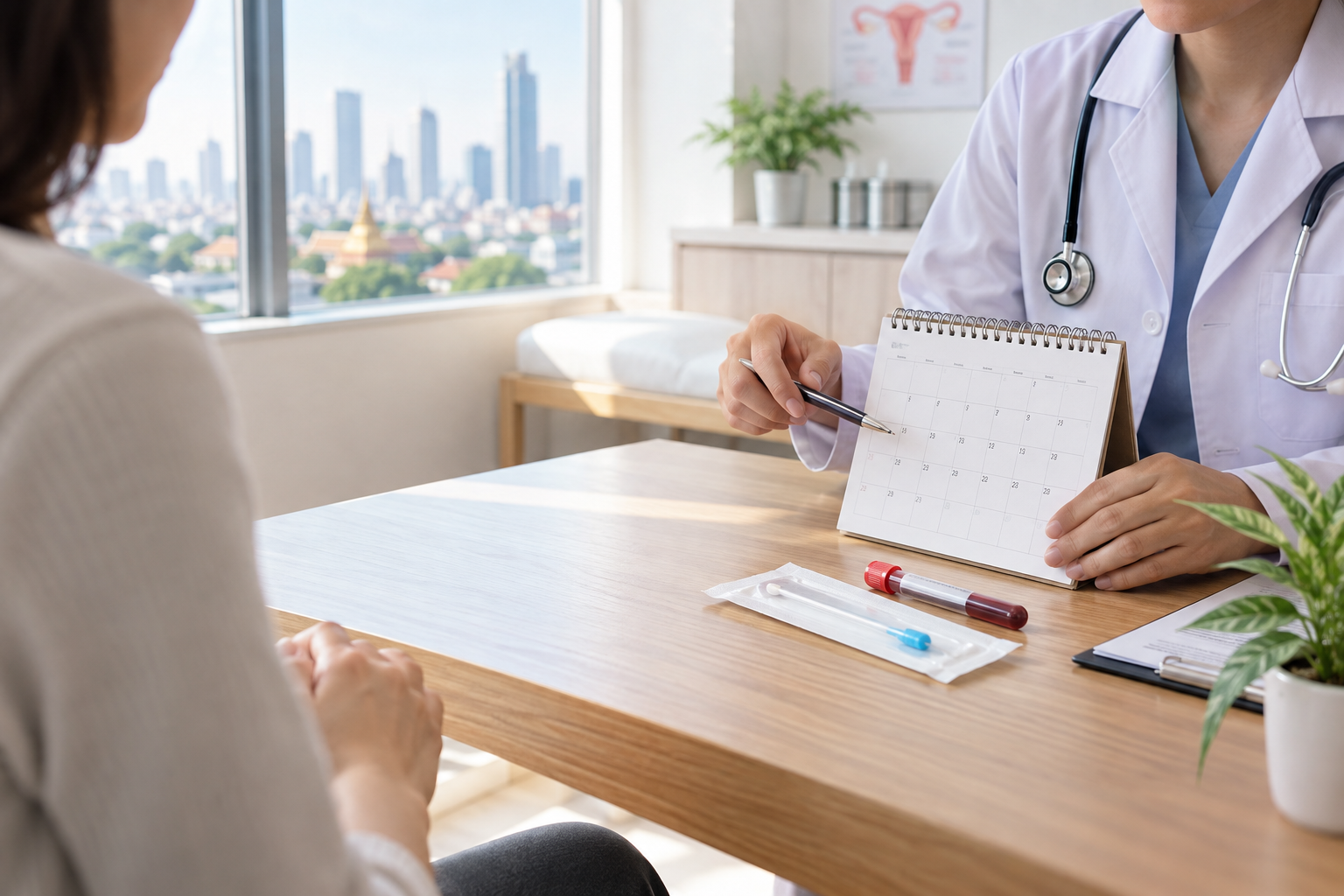
How Long After Sex Should You Test for STDs?
Understand testing windows, when to test after an exposure, and when a follow-up may be helpful.
There is no single number of days that answers this question for every infection. The best time to test depends on the infection being considered, the test method, the type of sex, the body site exposed, and whether you have symptoms. Testing too early can produce a negative result before an infection is detectable, so good timing matters.
If you are worried after sex, a clinician can help you separate what needs attention today from what should be tested after a window period. This is often more useful than waiting in silence or buying a broad test without knowing whether it fits your situation.
What is a window period?
A window period is the time between an exposure and the point when a particular test can usually detect an infection. It is not the same for every STI, and it is not the same for every test. Some tests look for the organism or its genetic material; others look for antigens or antibodies your body produces. Each becomes informative at a different time.
This is why an early result should be interpreted alongside the exposure date. A negative test taken very soon after sex may be reassuring in some contexts, but it cannot always rule out a recent infection. A clinician may suggest a baseline test now, a targeted test at a later date, or both.
Start with the exposure, not a generic timetable
When you speak to a clinic, share when sex happened, whether it was vaginal, anal, or oral, whether barriers were used, whether a condom broke or slipped, whether your partner has symptoms or a known diagnosis, and whether you have symptoms. These details help decide which samples are needed. A urine sample may be relevant after some genital exposures, while throat or rectal swabs may be important after oral or anal sex. Blood tests may be used for infections such as HIV and syphilis.
Do not assume a standard panel tests every body site or every infection. Ask what is included, what sample will be taken, and whether a repeat test is recommended.
HIV testing windows
HIV testing is a common source of anxiety because several test types exist. The CDC describes the following typical detection windows after exposure: a nucleic acid test (NAT) may detect HIV in roughly 10 to 33 days; a laboratory antigen/antibody test using blood from a vein in roughly 18 to 45 days; a rapid antigen/antibody finger-stick test in roughly 18 to 90 days; and an antibody test in roughly 23 to 90 days. These are ranges, not promises for any one person.
A laboratory antigen/antibody test is commonly used in clinical settings. If acute HIV is suspected very soon after exposure, a clinician may consider an HIV RNA test in addition to standard testing. If an early test is negative, repeat testing after the relevant window period may still be advised. Learn more about the clinic’s HIV testing options in Bangkok.
Chlamydia and gonorrhoea: sample the right site
Chlamydia and gonorrhoea are usually tested with molecular methods, often called NAATs. The most useful sample depends on where contact occurred: urine or a genital swab may be appropriate for genital exposure, while throat and rectal swabs can be important for oral and anal sex. An infection in the throat or rectum may not be found by a urine test alone.
In post-exposure guidance, the CDC notes that NAATs at sites of exposure can be repeated 1 to 2 weeks after exposure if initial testing was negative and no presumptive treatment was given. Your situation may be different, especially if you have symptoms, so use that timing as a reason to ask a clinician rather than a reason to delay an assessment.
Syphilis and the value of follow-up
Syphilis is diagnosed using blood tests, often in combination. The infection may not be detectable immediately after exposure, and repeat testing can be important when exposure is recent. In the CDC’s post-exposure guidance, when initial syphilis testing is negative and infection in the source cannot be ruled out, follow-up testing may be considered at 4 to 6 weeks and again at 3 months. A new sore, rash, swollen glands, or other symptoms should be assessed promptly rather than waiting for a planned test date.
Other tests have their own timing
Hepatitis B and hepatitis C testing choices and follow-up depend on vaccination status, the type of exposure, the particular test, and medical history. Herpes testing is more complex: swabbing a new visible sore can be useful, while blood tests have limitations and should be discussed with a clinician. HPV is not diagnosed through a routine blood test, and screening approaches differ by anatomy, age, and clinical context. Trichomoniasis testing is often considered based on symptoms, anatomy, and exposure.
For this reason, the most responsible answer to “when should I test?” is not a long checklist of isolated days. It is a focused plan based on your risk and the test being used.
Get a testing plan that matches your timing
Tell the clinic the date of sex, the type of exposure, and whether you have symptoms. A doctor can advise whether to test today, what to include, and whether a repeat test is useful.
You can also review STD test packages in Bangkok before your appointment.
If you have symptoms, do not wait for the perfect day
Symptoms such as unusual discharge, painful urination, sores, a rash, pelvic pain, testicular pain, or anal pain should be assessed promptly. Testing may be indicated immediately, and a clinician can explain whether it needs repeating later. Avoid taking antibiotics without medical advice. The right diagnosis matters, and using an inappropriate medicine can complicate care.
Testing after a negative result
A negative result can mean no infection was detected by that test at that time. Whether it is conclusive depends on timing and method. Ask three simple questions: What did this test look for? Was it taken after the relevant window period? Do I need a different sample or a repeat test? Clear answers make it much easier to know what a negative result means.
Protect yourself while you wait
Until you have clarity, consider using condoms or barriers consistently and avoid sex if you have symptoms. If a clinician diagnoses an STI, follow the treatment advice and discuss partner notification. Testing is one part of sexual health; regular communication, vaccination where appropriate, and prevention options such as condoms, HIV PrEP, or PEP assessment can also matter.
Key points
- There is no universal waiting period for all STD tests.
- Test method and body site matter as much as the date of sex.
- Early negative results can require follow-up.
- Symptoms and a possible exposure within 72 hours that could involve HIV both deserve prompt medical advice.
- A private consultation is the fastest route to an accurate, individual plan.
Medical references: CDC: Getting tested for HIV; CDC: Post-exposure prophylaxis recommendations; WHO: Laboratory and point-of-care diagnostic testing for STIs.
Leave a Reply